
The first time I carried a cat through an airport security line, I was sixty years old and certain every soul in that building could hear my heart going. Juniper was four, nine pounds, and she had howled the whole twenty-minute drive to the airport. I had a soft carrier over my shoulder, a folded printout of the airline's pet rules in my pocket, and no idea whether any of it would hold up. That was September 2024, Lubbock to Colorado Springs with a connection in Dallas. It is still the only flight I have ever taken with an animal.
The carrier was a Sherpa Original Deluxe, size Large. I bought it in August, a month ahead, because I wanted time to get Juniper used to it before I asked her to ride under a seat for the better part of a day. I have now owned that bag twenty-seven months. It is the oldest piece of travel gear I own, and it goes on every drive to Colorado Springs and every trip to the vet. What follows is the order I would tell it to a friend, starting with the phone call most people skip.
The one piece of gear worth sorting out before you book the ticket
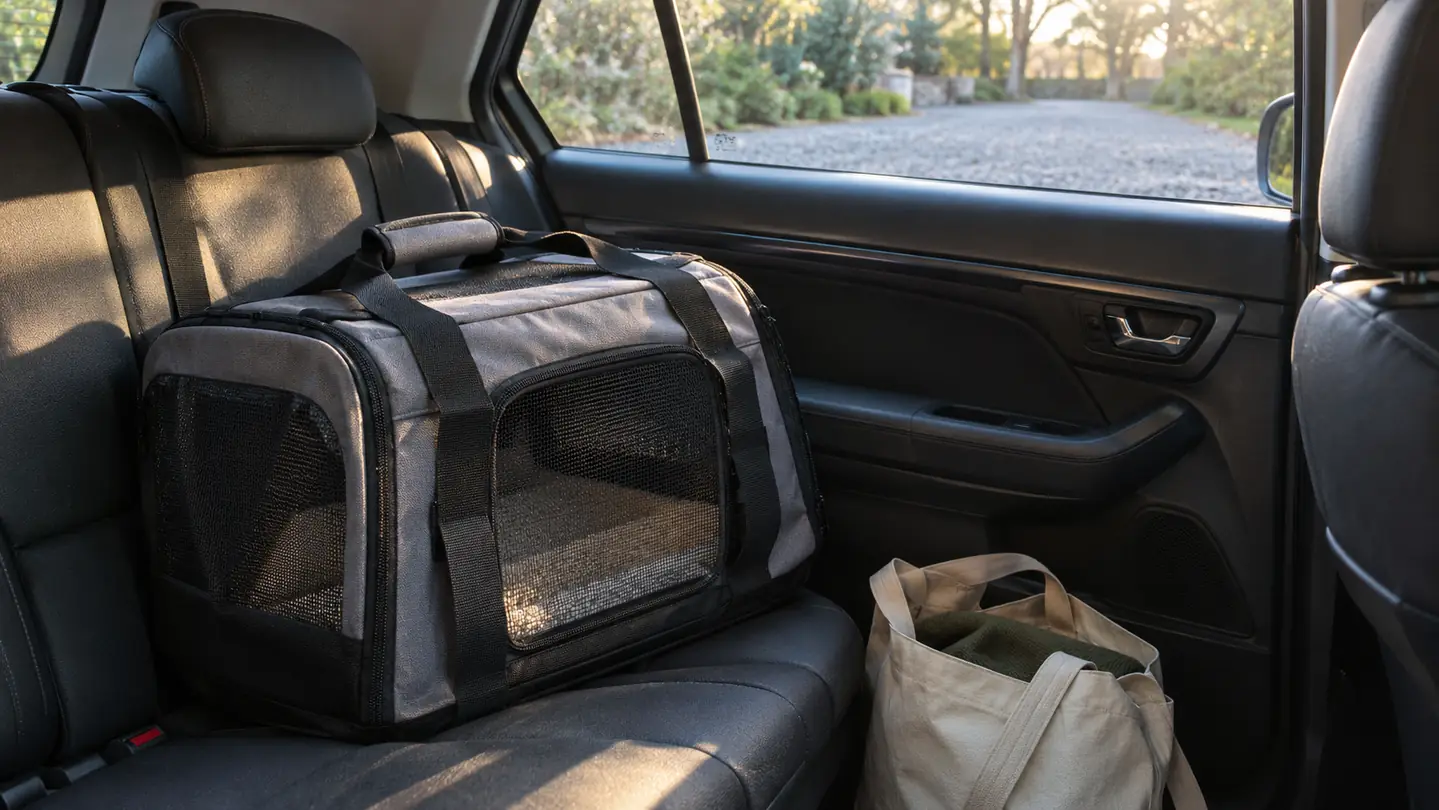
The Sherpa Original Deluxe is what Juniper flew in, and what she still rides in every week. Its listing says Guaranteed On Board, it is 19 by 11.75 by 11.5 inches, and it fits pets up to 22 pounds.
Amazon Check Today's Price on Amazon →Step 1: Call the airline before you spend a dime
Size limits are not the same from one airline to the next, and they are not even the same from one plane to the next on the same airline. I called and asked three questions. What is the maximum carrier size for a cabin pet. Does this flight allow a cat in the cabin at all. And what does it cost to add one. Write the answers down and put the paper in your bag. Cell service in a terminal is a gamble and I do not care to gamble with a cat.
The Sherpa is listed at 19 inches long, 11.75 wide and 11.5 tall, three pounds empty, and it fits pets up to 22 pounds. Juniper is nine, so she was well inside that. But a bag that fits one airline's limit will not automatically fit the next one's, and no listing on earth can tell you what the gate agent will say on the day you fly. The call takes fifteen minutes. I made it twice, once when I bought the bag and again the week before we left. I am glad I did, because the second call got me a different answer about the connection.
Ask one more thing while you have them on the line. Ask whether the pet counts as your carry-on or as your personal item. I had a small backpack and the carrier and I needed to know which one I was putting in an overhead bin. It turned out the carrier went under the seat in front of me either way. I would still rather ask than argue at a gate with forty people behind me.
Step 2: Measure the cat, then let the carrier do the squeezing
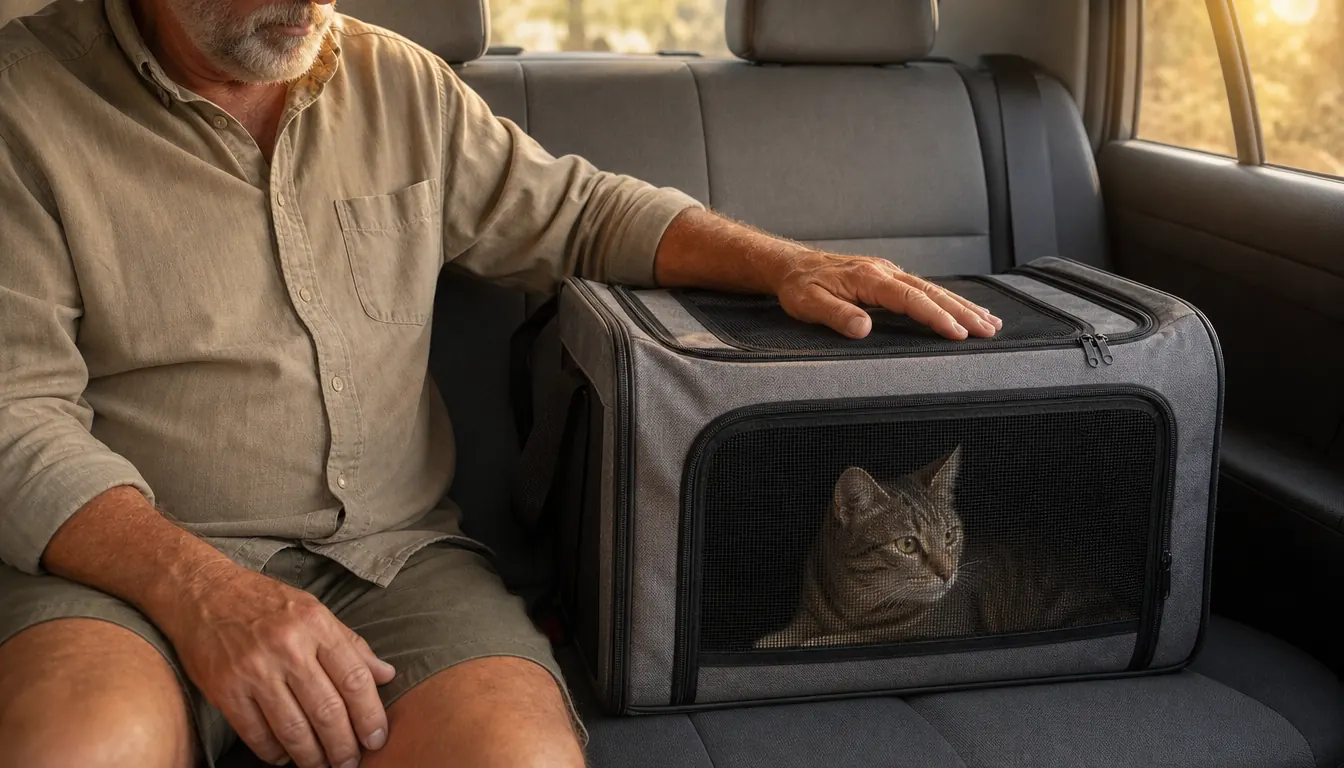
The part of this carrier that matters most on a plane is not the part you notice in a photograph. Sherpa's listing describes a patented spring wire frame that lets the back end of the carrier be pressed down several inches. That is the entire trick, and it is the reason a soft bag works where a hard one does not. The seat in front of you does not care how tall your bag is. It cares how tall your bag is willing to become.
I got down on my knees in the living room and tested it, because I am not the sort of person who takes a manufacturer's word for a thing I will be depending on in public. I pressed the back down, held it, let it go. It came right back up. Twenty-seven months later it still comes right back up, which says something about a wire frame that has been squashed into a CR-V, shoved under an airplane seat, and carried up a flight of stairs at my daughter's house twice a year.
Measure your cat before you buy, and measure the long way. Juniper is longer than she is tall and she likes to lie stretched out, so the 19 inches mattered more to me than the 11.5. She can turn around in it. She cannot stand up straight in it and she does not try. A cat that is used to being in a carrier will curl up and sleep. A cat that is not used to it will let the whole cabin know about it, and there is no bag on the market that fixes that.
Step 3: Two weeks in the living room beats two hours of coaxing at the gate
I left the Sherpa open on the living room floor for two full weeks before the flight. Liner in, one of my old T-shirts inside, the flap folded back. I did not put her in it. I did not nudge her toward it. I set a couple of treats near the opening and then I ignored the thing, which about killed me, because I am a fixer and ignoring a problem is not in my nature.
Somewhere in the second week she walked in on her own and sat down. That was the whole training program. Two weeks of stepping over a carrier in my own living room, and she loads herself now. Every vet run, every drive north, she goes into the back seat on the passenger side and I close the flap. No fight, no scratched forearms, no drama in the driveway at six in the morning.
Now the honest part. She still howls for the first twenty minutes of any car ride. She has done that since she was a year old and this bag did not change it. What the bag changed was the loading. I will take the trade. The howling stops on its own once we are past the edge of town, and I have quit expecting gear to do a job a cat has to do for herself.
The carrier did not fix the howling. It fixed the loading, and I will take that trade every time.
Step 4: Know what happens at security before you get there
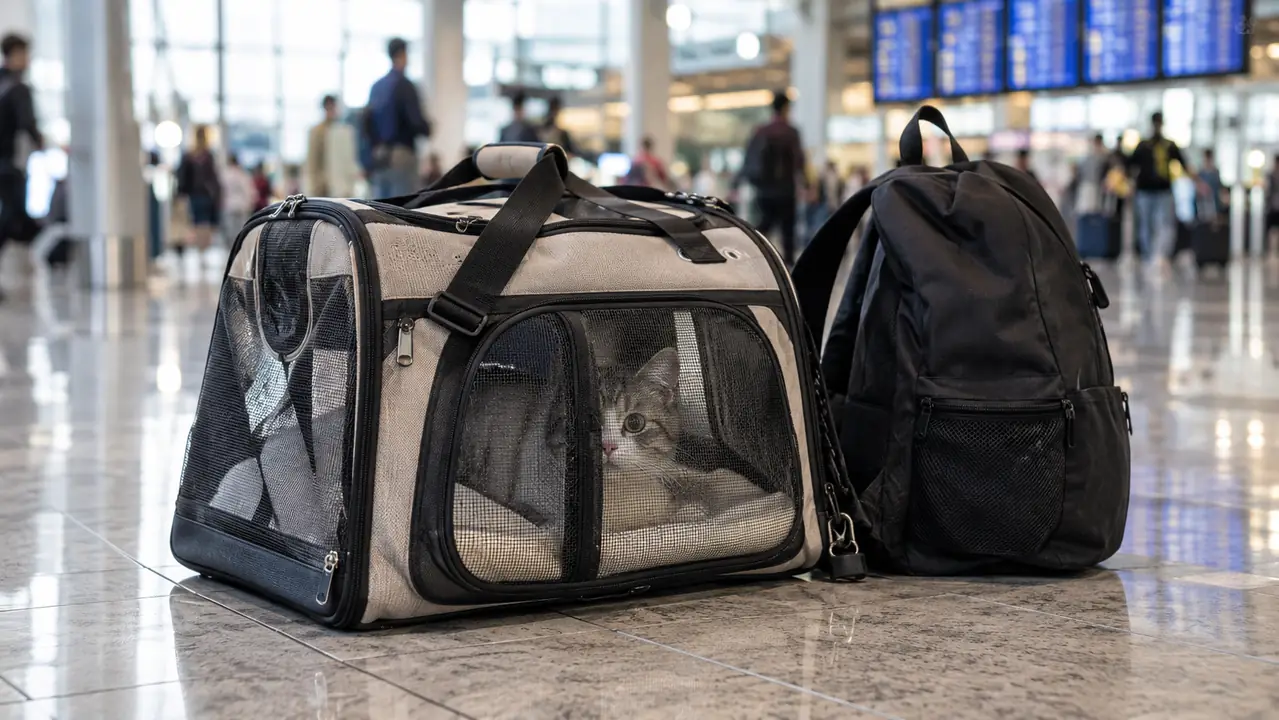
The cat comes out of the bag at security. That is the rule, there is no version of this where the cat rides through the scanner, and nobody at the checkpoint is going to make an exception for a gray cat and a nice older lady. So you need a plan for the thirty seconds when your animal is in your arms in a public building with a hundred strangers and a moving walkway.
What I did: one hand under her chest, one flat on her back, and I walked through the metal detector and did not stop moving until I was on the far side of it. She did not bolt. She did not enjoy it. What I did wrong: she had nothing on her but my two hands. If I flew again I would ask Dr. Pruitt about a harness for those thirty seconds, because a nine-pound cat can get out of two hands if she wants to badly enough.
The bag itself goes through the machine empty, so it needs to be something you can flatten and shake out without a fuss. The Sherpa comes with a liner and a detachable carrying strap. I left the liner in and sent it through with the bag, and the strap came off and went into the bin with my shoes. Get to the airport early. Not thirty minutes early. Two hours. A cat in a carrier is a conversation starter in a way a cat in a living room is not, and every kind soul who stops you costs you a minute.
Step 5: Set the carrier up for the seat, not for the walk
In the terminal, use the detachable strap across your body and save the padded top handle for when you are standing still. Across the body keeps both hands free, and you will need both hands for your license and your boarding pass and your shoes and the plastic bin. The strap comes off in about two seconds once you reach your row, and it goes into your bag so it is not hanging in the aisle tripping a flight attendant.
Under the seat, turn the opening toward you. That way you can reach a hand in without unzipping the whole bag and letting a cat look out at an open aisle. I flew with one finger in through the top of the carrier for most of that trip and Juniper settled against it and slept. That is not from any manual. That is just what a cat wants, which is to know you have not left.
And I did not open that carrier in the air. Not once, not for a minute, not even when she went quiet and I wanted to check on her. A cat loose in a cabin is a nightmare for every person on the plane, and Juniper is quicker than she looks. She rode from Lubbock to Dallas, sat through the connection, and rode on to Colorado Springs. She came out of that bag exactly once, on the floor of my daughter's guest room, and she came out at a dead run.
What Else Helps
The carrier is the piece you cannot skip, but it is not the whole trip. I keep a canvas tote on the back floor of the CR-V with a collapsible bowl, a zip bag of Juniper's usual clumping litter, a small folding litter box, and a jug of water from home. The water from home matters more than the rest of it. She will not drink strange water, and a cat who will not drink on a travel day is a cat I worry about. For the flight I packed a collapsible bowl in my carry-on and offered it at the gate, and she took about four laps and quit.
I also carried a thin towel and draped it over the carrier once we were seated. The cabin lights and the foot traffic were more than she wanted to look at, and behind that towel she quieted down inside ten minutes. Whether it was the towel or the engine noise, I could not tell you. It weighs nothing and it does no harm, so it goes in the bag every time now.
The second life of this bag is the one I did not plan for. The listing calls it a soft-sided crate for regular outings and vet visits, and that is exactly what it became. It lives by the back door now. Dr. Pruitt's office is nine minutes from my house and the Large is more carrier than Juniper needs for a nine-minute ride, but she is comfortable in it, and comfortable beats correctly sized every time.
Before this bag I had a hard-sided plastic carrier from the pet store. I gave it to my neighbor Lou the same month I bought the Sherpa and I have never once missed it. A hard carrier does not give when a seat back comes down in front of you and it does not fold flat in a trunk. If you already own one for vet visits, keep it. Just do not expect an airline to be glad to see it.
One last thing, and it is the thing I would want somebody to say to me. Practicing the whole trip at home is free and almost nobody does it. Put the carrier in the car, put the cat in the carrier, drive around the block, come home. Do that three or four times before you ever point the car at an airport. Juniper howled through all of it anyway. But she walked into that terminal already knowing the bag was not going to eat her, and I figure that is about the most a person can ask for.
Twenty-seven months, one flight, and it is still the bag by my back door
If you are flying with a cat in the cabin, start with a carrier the airline has heard of and your cat has already slept in. The Sherpa Original Deluxe has been both for me. Call the airline first, then order.
Amazon Check Today's Price on Amazon →