Nine hours is a long stretch for a dog to go without a drink. I know, because I have driven it four times now, from just outside Lubbock up to Colorado Springs, with a beagle mix named Biscuit and a gray cat named Juniper in the back of a 2018 Honda CR-V. For the first couple of years I did what most people do. I offered water when we stopped and hoped for the best. Biscuit would hop out, sniff the asphalt, ignore the bowl entirely, and then spend the last two hours of the drive panting and pawing at the seat. Juniper howled for twenty minutes and then sulked in her carrier with her back to me.
What fixed it was not a gadget. It was two SLSON collapsible bowls, a small two pack that came with a carabiner for each one, plus a gallon jug of water from my own kitchen tap and a few habits I had to learn the hard way. Before that I had tried a travel water bottle with a flip-out trough. It leaked into my bag on a state park weekend and I threw it out the same month the bowls arrived. If you are planning a long drive with an animal and you have not sorted out water yet, here is the whole routine, in the order I actually do it.
Two bowls, two carabiners, and a nine hour drive that stopped being a problem
The pair rides on the tote in the back floor of my CR-V. One is Biscuit's, one is Juniper's, and neither has leaked on anything yet.
Amazon Check Today's Price on Amazon →The Five Steps I Actually Use
Step 1: Clip the Bowls Where Your Hand Already Goes
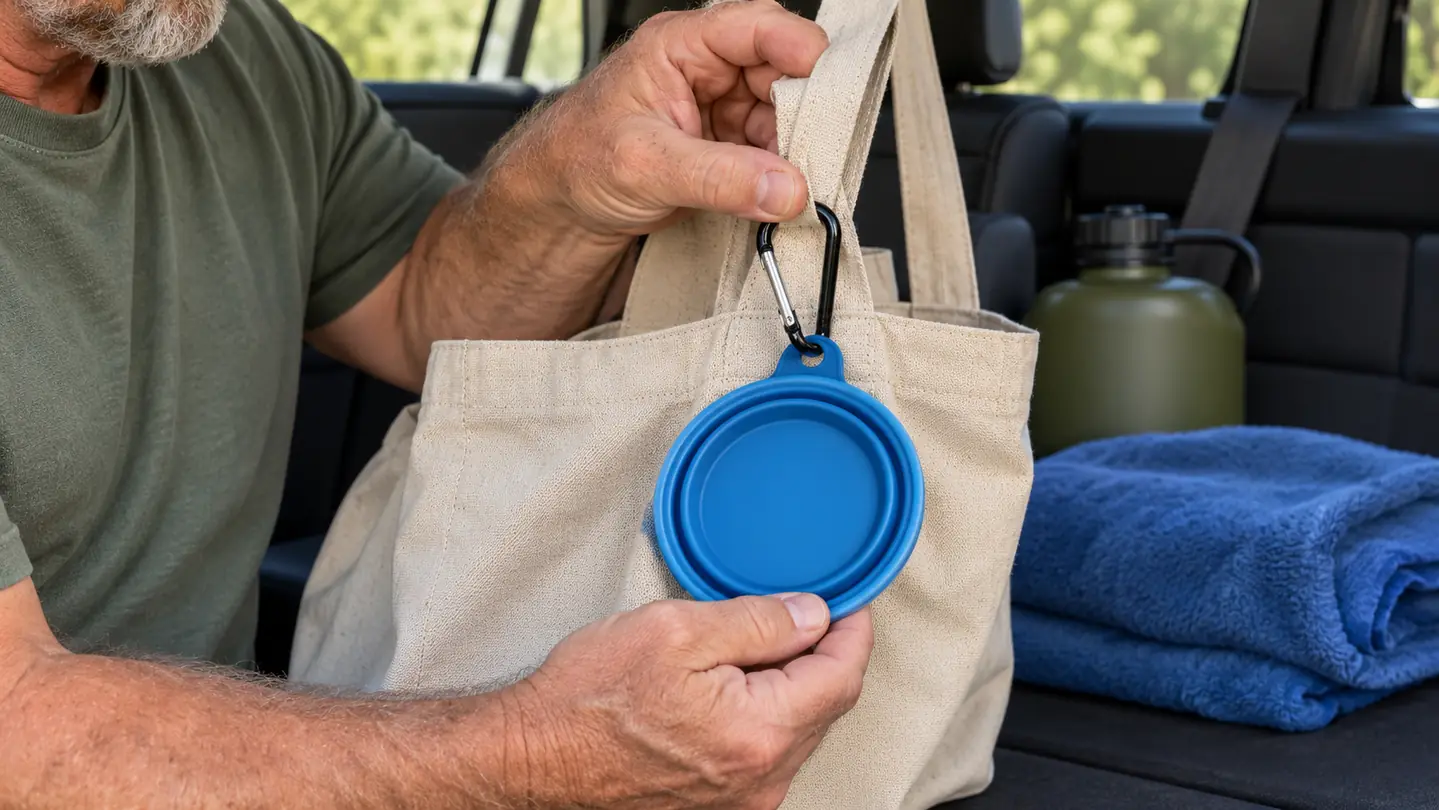
The SLSON bowls come as a two pack with a carabiner for each. The first thing I did was clip both of them to the handle of the canvas tote that rides on the back floor of the CR-V. Not the trunk. Not the console. The tote, where my hand already goes for the litter box and the water jug. If a bowl is buried under a suitcase, you will not dig it out at a windy rest area outside Amarillo. You will tell yourself the dog is fine and you will keep driving.
I tried the alternatives first, and I want to be honest about them because they cost me money. In June 2024 I bought a travel water bottle with a flip-out trough. The idea was one hand, no bowl, just squeeze and let the dog lap. What actually happened was that the seal gave out somewhere between Lubbock and Post and the inside of my bag got damp. On a state park weekend that fall it leaked again, worse, and I decided I was done with it. The SLSON bowls replaced it in May 2025, the month after the April drive, and I have not touched a travel bottle since.
Blue is Biscuit's and green is Juniper's, and I have never once mixed them up. That is partly organization and partly because a beagle will drink out of anything and a cat will not. Each bowl holds 12 fluid ounces, which is a real drink at a stop without leaving half of it to slosh around. Expanded, a bowl measures about 5.1 by 3.5 by 2.1 inches, which is roughly the footprint of my hand. Folded, it is half an inch tall. With the two of them clipped to the same handle, I can carry both in one hand along with the tote.
The whole pair weighs next to nothing, a few ounces, so there is no good argument for leaving them at home on a short trip. That matters more than you would think. The vet runs and the weekend at a state park are exactly the trips where I used to forget water entirely, because they felt too short to bother with.
Step 2: Offer Water at Every Stop, Not Just the Long One
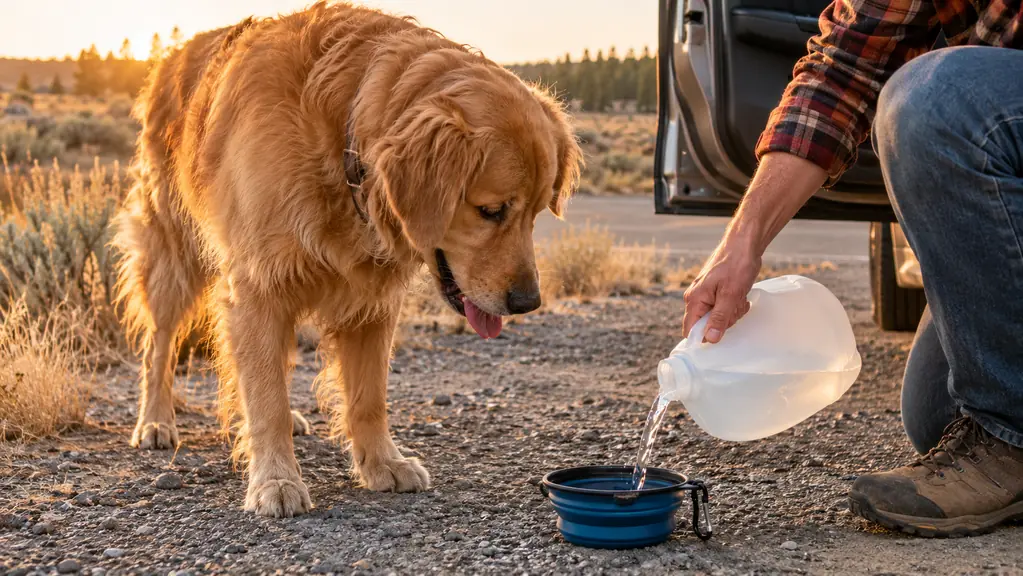
For the first two Colorado drives I only offered water at Raton, New Mexico, the one long stop where we all get out and walk around. That was my mistake. Nine hours with a single water break is not enough for a dog, especially with the afternoon sun coming through the back window. Now the bowl comes out at every stop, including the ten minute ones where I am really only stretching my own legs.
The routine is about as complicated as making toast. I set the bowl on the ground away from where the cars are pulling through, pour from the jug, and let Biscuit drink what she wants. Then I fold the bowl and put it back. I do not leave water standing in it while the car is moving, because a bowl of water in a moving car is a bowl of water on your back seat, and I learned that one in a single afternoon. The first time I tried it, I set a full bowl on the floor of the back seat just past Childress and made it about eight miles before a curve sent the whole thing across the mat. That mat went in the wash that night at Beth's, and the bowl never rode open again.
One habit worth building: let the dog drink, walk her a little, then offer the rest. Biscuit used to drain a bowl in one go and then want to run, and that never ended well. A short walk between drinks settles her. I am not a vet and I do not give medical advice, so if your animal has a health condition, ask your own vet before a long drive. Dr. Pruitt has answered that question for me more than once.
Step 3: Give the Cat Her Own Bowl and Her Own Quiet
Juniper is a different animal, in every sense. She howls for the first twenty minutes of any ride and then goes silent and sulky. She barely drinks until we get to Beth's house. For a long time I assumed that was just how cats travel and there was nothing to be done about it.
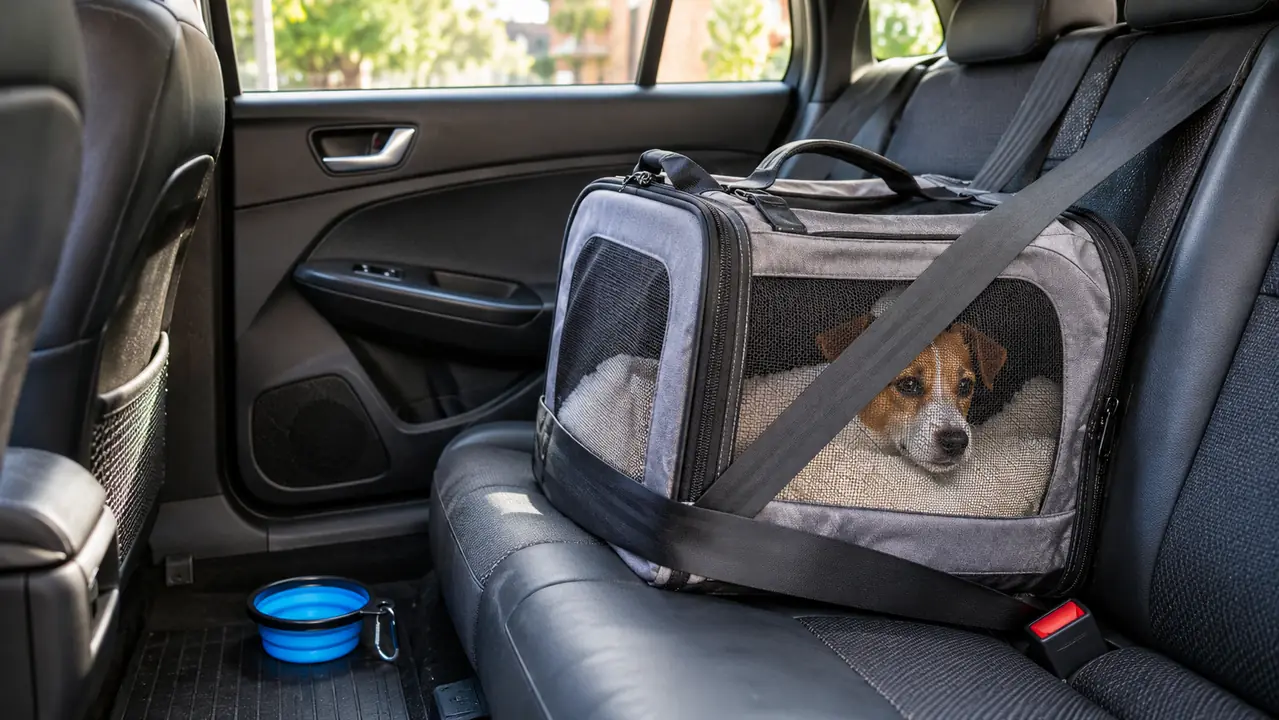
What actually works for her is quiet and a shut car. At Raton I park, close the doors, open her carrier, and set her green bowl on the floor mat beside it. Then I get back in the front seat and look at my phone for ten minutes and pointedly ignore her. If I stand over her, she will not drink. If the doors are open and trucks are rolling past, she will not drink. Give her a closed car and no audience and she will take a few laps.
The first time I tried it, in October 2025, she looked at the bowl, looked at me, and turned around and sat down with her back to it. I counted that as a no and we drove on. At the second offer, somewhere south of Trinidad, she drank. Two trips later she started drinking at the first offer instead of the second, which for a cat is a major concession. She still does not drink much on the road. That has not changed and I do not expect it to. But she drinks more than she used to, and offering costs me nothing.
Biscuit drinks at every stop now instead of waiting until we get there. That is the entire change, and it took two folding bowls and a carabiner.
Step 4: Bring Water From Home
I fill a gallon jug from the kitchen tap before I pull out of the driveway, and it rides in the tote next to the bowls. Part of that is practical: I am never hunting for a working faucet at a rest stop with two animals waiting in a hot car. Rest stop sinks are for washing hands, not for filling a jug. I made that mistake exactly once, at a station outside Vega, and spent four minutes fighting a faucet that only ran when I held it with one hand while Biscuit barked at a semi.
The other part is that a cat who is already out of sorts does not need a change in her water on top of everything else. Juniper is finicky about most things. Same water, same bowl, same routine is one less thing for her to object to. If your animal has a sensitive stomach, this is cheap insurance and it costs you nothing but the weight of the jug. A gallon covers two animals for a nine hour day with water left over for the return leg.
At Beth's I dump whatever is left, rinse the jug, and refill it from her tap for the drive home. On the road I top off the bowls from the jug and never from a random spigot. It sounds fussy written down. In practice it is one jug, one tote, no thinking.
Step 5: Rinse, Fold, and Put Them Back Where They Belong
At the end of each day I rinse both bowls in the sink, shake them out, and leave them open on a dish towel to dry. Soft plastic will hold an odor if you fold it away wet and leave it in a hot car for a week. I know because I did exactly that once, in October, and I could smell it from the front seat by the time we hit Childress. It took a soak in warm water and a couple of days open on the counter to come back around.
Once they are dry, they fold down to half an inch and go right back on the carabiner on the tote handle. That is the part that keeps the whole system working. If the bowls end up in a kitchen drawer instead of the tote, they are not in the car the next time somebody gets sick or the drive runs long. They live in the CR-V. That is the deal.
The listing describes a two year warranty on the bowls. I have not needed it. Eighteen months in, both bowls have been rinsed and refolded on four Colorado drives and a handful of state park weekends, and neither one has split or leaked.
What Else Helps
Water is one piece of a bigger setup, and I would be lying if I said the bowls did all the work. The hammock across the back seat is what made cleanup after carsickness a ten minute job instead of an hour. The harness and its tether are what keep Biscuit in her spot and out of my lap. The Sherpa carrier is what lets Juniper settle instead of fighting me at the door. And the small travel litter box is what keeps a cat from holding it for nine hours straight. None of those are water-related. All of them matter on the same drive.
One thing I changed after too many bad afternoons: I do not feed Biscuit a big meal right before we leave. A lighter meal a couple of hours out, then water at the stops, and we have had far fewer incidents. I am not telling anyone how to feed their dog. I am telling you what stopped me scrubbing the back seat in a gas station parking lot with a roll of paper towels and a bottle of dish soap.
The last thing is the least popular one. Know your own animal before you build a system around somebody else's. Juniper will not drink in a moving car no matter what I do, so I stopped fighting it and started offering water when we are parked and quiet. Biscuit will drink anywhere, anytime, out of anything, so hers is easy. Your dog or cat will have its own quirks, and the bowls are just the thing you unfold while you figure them out.
The bowls live on the tote now, and the jug gets filled before every drive
Small size, 12 fluid ounces each, two carabiners included. One for the dog, one for the cat, both clipped where your hand can reach them at the next rest stop.
Amazon Check Today's Price on Amazon →