
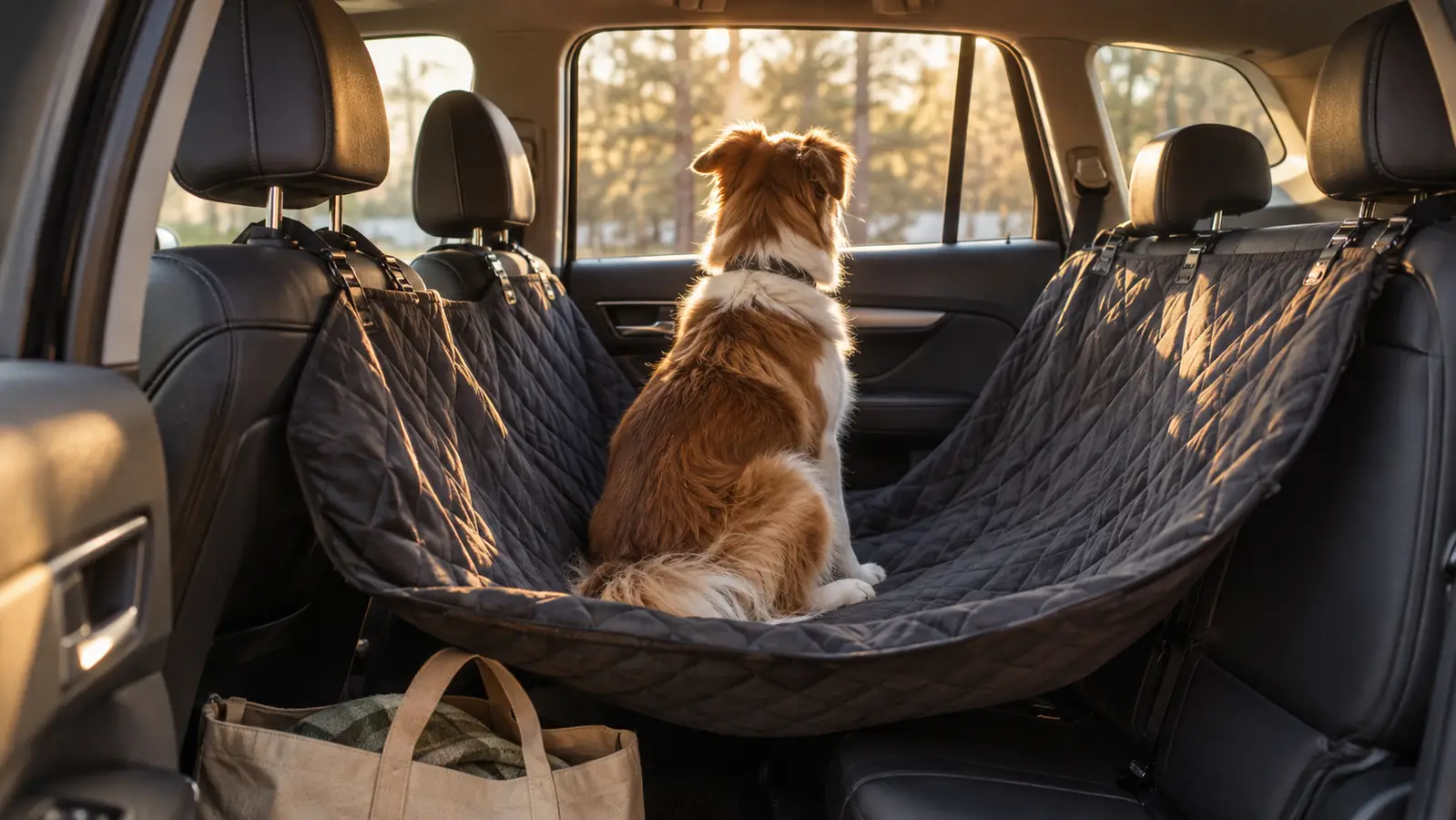
Short answer: the harness. The Kurgo Enhanced Strength Tru-Fit Smart Harness, in a Medium, with the 10-inch tether that comes in the box. I have run both setups on the same dog, the plain tether first and the harness ever since, and the difference is not subtle.
Here is what I ran before that. For longer than I care to admit, I clipped a plain seat belt tether to Biscuit's collar. Biscuit is my 6-year-old beagle mix, 28 pounds, and she has a strong opinion about every new smell between Lubbock and the New Mexico line. The plain tether was cheap and it did keep her in the back seat of my CR-V, which was the whole point as far as I knew. What I did not think through was that everything she did, every lunge at a window, every scramble when I tapped the brake, went straight into her throat.
Then a hard stop on Highway 84 outside Post happened. She hit the end of that tether and coughed. Not a polite cough. The kind where you take your foot off the brake, turn around in your seat, and put a hand on the dog's chest. I pulled into the next gas station, unhooked it, and drove the rest of the way with her loose on the hammock giving me looks. A few days later the Kurgo arrived. That was April 2025, and she has worn it on every drive since, including four Colorado runs and more vet trips than I want to count.
So this is not a close call for me. But I want to be honest about where the plain tether is fine, because it is fine in some cars with some dogs, and I am not going to pretend otherwise just because I bought the nicer thing.
| Kurgo Tru-Fit | Plain seat belt tether | |
|---|---|---|
| What it attaches to | Buckles around the chest and body, then the included 10-inch tether clips to the seat belt with a steel carabiner | One clip to the collar, one clip to the seat belt |
| Where a sudden stop lands | Across the padded chest plate | On the neck |
| Adjusting the fit | Five points of adjustment, and it took me two tries | Nothing to adjust, so nothing fits |
| Putting it on | A buckle, a chest plate, and about a week of a dog backing away | One clip, two seconds |
| Walking at a rest stop | Stays on, because it is a walking harness too | Comes off, and the leash goes back on the collar |
| Cleaning | Hand wash only, and it has to air dry | Wipe it on your jeans |
| Storing it in the car | Lives on the dog or bunched in the tote | Folds into a door pocket or the glove box |
| Crash claims | The listing describes it as crash tested. I have never tested it and have never been in a crash | No crash claim at all |
| Warranty | Lifetime warranty | No warranty |
| Best for | A dog that pulls, rides far, and walks at stops | A calm dog on short hops |
Read that table honestly and you get the shape of it. The Kurgo wins the things that matter on a nine-hour drive and loses a couple of the small daily conveniences. Both of those things are true at once, and I would rather you know it before you spend anything.
Where Kurgo Tru-Fit Wins
The pressure is the whole argument. The harness has a padded chest plate, so when Biscuit lunges at a cow or the mud flap of a passing semi, the car stops her with her whole front instead of her throat. On the hammock she can stand, turn around three times, and lie back down, and she still cannot reach the front seat. That last part matters more than I expected. I drive alone with the animals, and a 28-pound beagle in my lap at highway speed is not something I want to find out about.
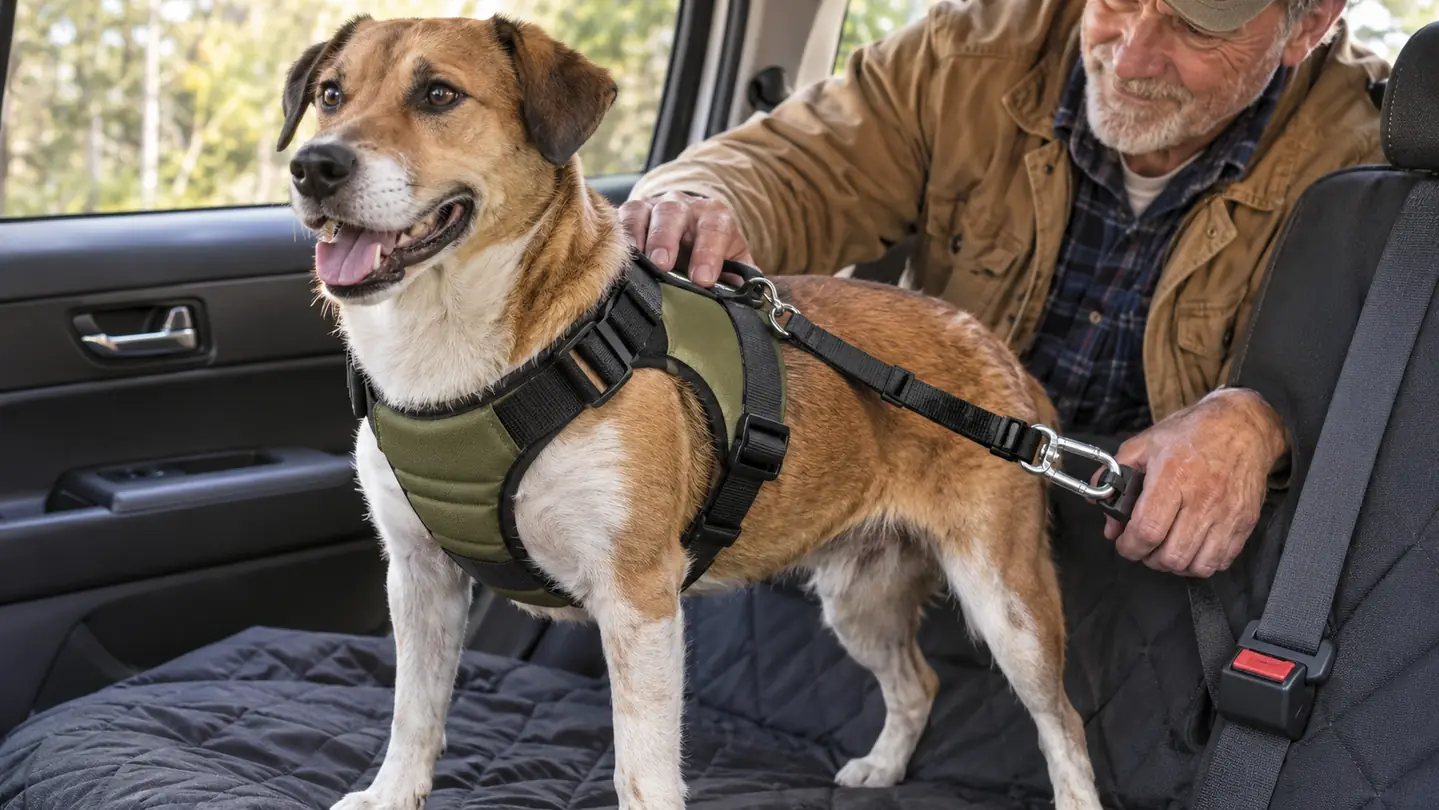
The fit is the second thing. Five points of adjustment, and the listing says it fits dogs up to 75 pounds, so a Medium on a 28-pound dog is generous. I would rather adjust down than squeeze her. It took me two tries on the first weekend to get all five points where they belonged, and Biscuit backed away from the whole business for about a week before she quit arguing. That was 19 months ago. She walks up to it now. It is a walking harness too, so at the Raton stop I do not take anything off or put anything on. She steps out, we walk the gravel by the trucks, and she gets back in. There is a lifetime warranty on it that I have never had to use. The listing describes it as crash tested. That is all I can tell you about that, because I have never been in a crash with the animals in the car, and I would like to keep that sentence true.
Where a Plain Tether Wins
Speed. That is the honest answer. One clip on the collar, one clip on the seat belt, and you are done before the dog has finished sniffing the door handle. There is no fitting ritual, no chest plate, no five points to get right. If you have a calm dog who lies down and stays down, and your drives are eight minutes to the vet, the plain tether does that job. It did that job for me for a good while.
Cleaning and storage are the other two. I wipe the tether on my jeans and it goes in the door pocket. The harness says hand wash only, and hand wash only is a Saturday job, not a Tuesday one. It has to air dry, so you want to do it on a day you are not driving anywhere. If you are the kind of person who is not going to hand wash a dog harness, be honest with yourself about that before you buy one, because that is how a good harness ends up in a closet.
The harness that ended the coughing at the end of the tether
Biscuit has worn the Kurgo Tru-Fit on every drive since April 2025, including four nine-hour runs to Colorado Springs. The Medium fits dogs up to 75 pounds, and the 10-inch seat belt tether comes in the box.
Amazon Check Today's Price on Amazon →The Part Nobody Tells You About a Collar Tether
Nobody warned me, so I will warn you. A tether does not pull evenly. A collar sits high on the neck, right where the throat is, and when the car stops, the dog's forward weight goes into that band. Biscuit coughed. A heavier dog, or a faster stop, and I do not like to finish that thought.
I did not call Dr. Pruitt over a cough, but I thought about it the whole way home. What I did instead was take the tether off and drive the last forty minutes with a loose dog, which, looking back, was not the safer choice either. Neither animal rides loose in my car anymore. Not for a mile.
The tether kept her in the back seat. It just did it through her throat.
The week after, she backed away every time I picked the harness up. I did not force it. I left it where she could sniff it and put it on her for a minute at a time in the living room, and by the next weekend she had quit backing away. Two tries to fit it, one week of convincing. That is the whole story, and I am not going to dress it up as training advice.
How I Tested Both
I am not a gear tester. I am a retired school bus driver outside Lubbock who drives to Colorado Springs twice a year to see her daughter and two grandkids. I have one dog, one cat, one vehicle, a 2018 Honda CR-V, and a strong preference for things that work the first time.
The Kurgo has been on four Colorado drives so far: April 2025, October 2025, April 2026, and October 2026. Nine hours in one day each way, with one long stop at Raton, New Mexico. Same dog, same car, same hammock on the driver's side of the back seat. Before that, it was the collar and the plain tether, and I thought I was being careful.
I have never been in a crash with the animals in the car, and that limits what I can tell you. I cannot tell you how either setup behaves in a wreck, and I am not going to pretend a driveway test is the same thing. What I can tell you is how they behave on Highway 84, on the climb past Raton, and in a gas station parking lot with a dog who wants to smell everything.
The Nine-Hour Drive, Start to Finish
We leave before light. Biscuit rides on the hammock on the driver's side, in the harness, on the tether. Juniper rides in the Sherpa carrier on the passenger side, on top of the hammock, with the seat belt run through the carrier strap. Neither of them is loose, not for a mile. The canvas tote sits on the back floor with the bowls, the folded litter box, the zip bag of litter, and a gallon jug of water from home.
Amarillo is where Biscuit used to start fussing. With the collar tether she would stand up, sit down, stand up again, and every one of those moves ended in a jerk on her neck. With the harness she still stands up and sits down, but the stop comes soft against her chest and she settles faster. That is not a scientific measurement. It is what the rearview mirror shows me.
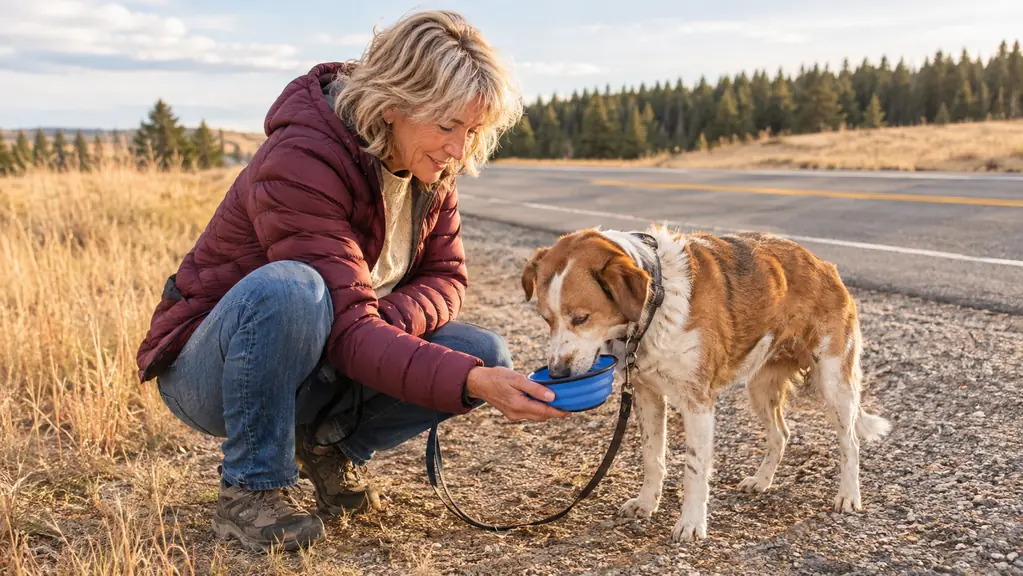
Raton is the long stop. I park at the back of the lot away from the trucks, set the litter box on the floor with the doors shut for Juniper, and walk Biscuit on the gravel in the harness. Both bowls get filled from the jug. Biscuit drinks at every stop now, which she did not used to do, and that is the bowls more than the harness. Then we get back in and she goes onto the tether without a fight, because she never came out of the harness in the first place.
What About the Cat
Juniper is my 4-year-old gray shorthair, 9 pounds, and she does not wear the harness. She never has and she never will. She rides in the Sherpa carrier on the passenger side of the back seat, on top of the hammock, with the seat belt through the carrier strap. The harness question does not apply to her, and I would not tell you to put a cat into a dog harness to solve a car problem. Different animal, different job. People ask me this at the vet's office more than you would think.
She has flown exactly once, in the cabin, Lubbock to Colorado Springs with a connection in Dallas, and that is the only flight I have taken with an animal. Biscuit stayed with my neighbor Lou. That is a whole other conversation, but the short version is that the airline's size limit is what decides it, and you should call the airline before you buy anything, because the limit is not the same on every plane.
Who Should Buy Which
Buy the Kurgo Tru-Fit if your dog pulls, if your drives are long, if you travel alone with the dog, or if your dog is big enough that a hard stop would put real weight on a collar. Buy it if you want one piece of gear that handles the drive and the rest stop both. Biscuit is 28 pounds and I would buy it again tomorrow for a 60-pound dog without blinking.
Stick with a plain tether if your dog is calm and small, if your trips are short, and if you know you will not fuss with five points of adjustment. That is a real answer, not a polite one. A tether that gets used beats a harness that stays in the closet. But if your dog has ever hit the end of a collar tether and made a sound you did not like, you already know which one you are buying.
One more thing, and then I will let you go. Neither one of these is a guarantee. I have never been in a crash with the animals in the car, and I do not know how either setup behaves in one. What I know is that the coughing stopped, the front seat is off limits, and I drive nine hours to see Owen and Lily twice a year without a dog standing on my lap. That is enough for me.
Nineteen months, four Colorado runs, one dog who quit arguing
The Kurgo Tru-Fit comes with the 10-inch seat belt tether and a lifetime warranty. Medium fits dogs up to 75 pounds. Hand wash only, so plan your Saturday around it.
Amazon Check Today's Price on Amazon →